
Scrap Balers, Made in Italy
Scrap Baler Price: What Drives It
Configured quotes · Installation included
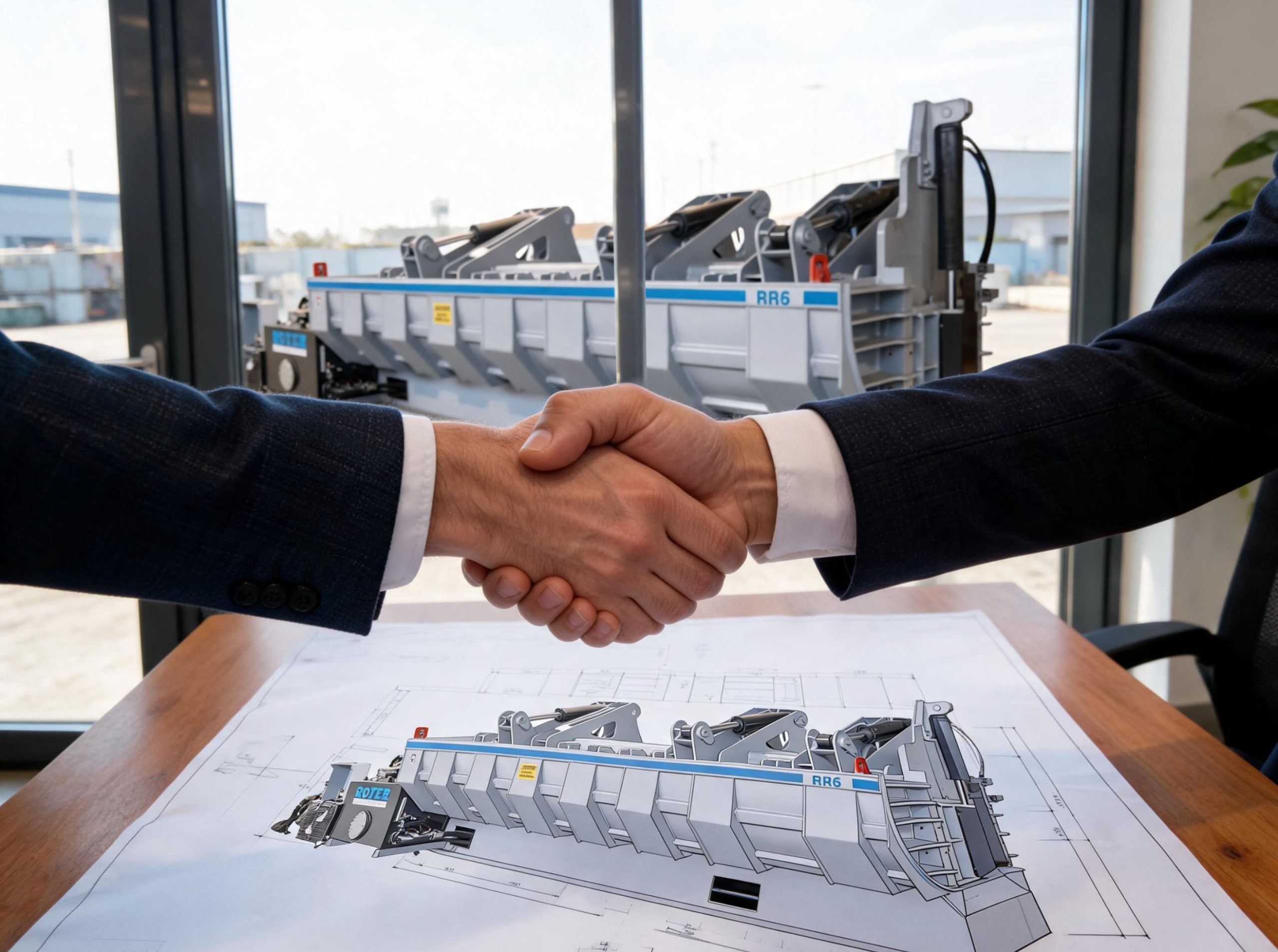
Scrap Baler Price: the Five Factors Behind Every Quote
On-Site Installation Included · Operator Training · Remote Diagnostics · Spare Parts From Ferrara
The price of a scrap baler is set mainly by five factors: the machine type (baler, shear baler or automatic baler), its force class and box size, the drive (diesel or electric), the configuration (fixed or mobile), and the options and support included.
Because every Roter machine is configured to the customer’s material, site and throughput, Roter does not publish a price list. It quotes each machine after a technical review, with on-site installation included.
Why a Fixed Price List Would Mislead You
Two yards can ask for “a car baler” and need very different machines. One works on mains power from a permanent station; the other moves a diesel unit on a trailer between three sites. A figure on a web page would be right for neither.
What a buyer can understand in advance is what moves the price, and that is the purpose of this page.
The Five Factors Behind Every Quote
1. Machine type
| Machine | What it does | Typical buyer |
|---|---|---|
| RR5 / RR6 baler | Compacts bulky and mixed scrap into bales | Car dismantlers, scrap yards, demolition sites |
| RR715.6 shear baler | Bales and cuts heavy ferrous scrap, with four programmes | Demolition contractors and high-volume yards |
| RA Series automatic baler | Continuous, PLC-controlled baling of production scrap | Industrial and steel plants |
A shear baler adds a cutting system to the press, so it sits in a different class from a baler. Read scrap baler vs shear baler before deciding which you need.
2. Force class and box size
Within each family, size matters: a 5 m or 6 m box on the RR5/RR6, the 715-tonne class of the RR715.6, or main cylinder forces from 70 to 140 tonnes across the six RA models. Size the machine to your heaviest regular material, not your average load, and not to your largest occasional one.
3. Drive
The RR Series runs on a Perkins or CAT diesel engine; the RR5/RR6 is also available with a 75 kW electric motor or a 90 kW option. See the electric scrap baler page for how to choose.
4. Configuration and site costs
The RR5/RR6 can be fixed, roll-on/roll-off, semi-mobile or mounted on a three-axle trailer, and it needs no foundation in any of them. That matters for the total project cost: no civil works before the first bale. See the mobile car baler configurations.
5. Options and support
Options shape both price and productivity: a grapple with rotor, cabin air-conditioning, cold-climate preheating, automatic greasing, a liquid collection tank or an emergency spare-parts kit on the RR5/RR6; lifting legs and preloading on the RR715.6; hoppers, chutes and a weighing system on the RA Series. On-site installation is included, and every machine is supported with training, remote diagnostics and spare parts from Ferrara.
Look at Lifetime Cost, Not Only Purchase Price
For a procurement manager, the purchase price is only the first chapter. A cheaper machine that waits a week for a part costs more than it saved. Ask every supplier the same questions: who installs it, who trains the crew, how faults are diagnosed, and how fast spare parts arrive.
Our procurement manager’s buying guide covers this in depth, and why we don’t offer a free baler trial explains how Roter sizes machines instead.
Baler types compared: vertical, horizontal, shear, automatic and mobile
Five machine families cover most scrap metal baling. They differ in how material is loaded, compressed and ejected, and therefore in throughput and price. Choose by material type, daily volume and whether you must cut oversized scrap as well as compress it.| Type | Best for | Throughput class | Relative price (indicative) | In the Roter range |
|---|---|---|---|---|
| Vertical baler | Small yards, workshops, light sheet and offcuts, low daily volume | Low | Lowest | Not offered |
| Horizontal hydraulic baler | Medium to high volumes of bulky and mixed scrap, end-of-life vehicles | Medium to high | Mid | RR5 / RR6 balers |
| Automatic baler | Continuous production scrap, low labour per tonne | Medium to high | Mid to high | RA Series automatic balers |
| Shear baler | Heavy, long or bulky scrap that needs cutting and compressing | High | High | RR715.6 shear baler |
| Logger / mobile baler | Demolition sites, multi-site operators, contract processors | Medium to high | Mid to high | RR5 / RR6 in semi-mobile, roll-on/roll-off or trailer-mounted versions |
New, used or mobile baler: which makes sense?
A new baler brings warranty terms, current safety documentation and planned spares. A used or refurbished machine lowers the entry price but adds condition and compliance risk. A mobile baler moves to the scrap instead of the other way round. The right answer depends on volume, capital budget and the downtime you can tolerate.- New. Best for steady, high-volume operations. You specify force, box and automation, and receive documentation, commissioning and training.
- Used or refurbished. Verify operating hours, cylinder and seal condition, liner and blade wear, electrical safety and spares availability, and ask for a documented inspection. Use the used and refurbished baler checklist.
- Mobile. Suited to demolition and multi-site contractors. Compare the mobile car baler and mobile shear baler configurations, and check road-transport rules, power source and set-up time.
- Leasing or financing. Ask every supplier whether it is available and on what terms; it can change the economics of a new machine.
How to compare baler manufacturers: a supplier evaluation scorecard
No single manufacturer is right for every buyer. Compare baler manufacturers with a weighted scorecard: send the same specification to each, score the written answers from 1 to 5 against the criteria below, and multiply by the weight. Treat missing answers as low scores, not as neutral.| Criterion | Questions to ask | Evidence to request | Suggested weight |
|---|---|---|---|
| Fit to your material and throughput | Which model for my scrap mix? What t/h on my material? | Capacity stated per material, not generic | 20% |
| Bale quality | What bale size and density, and which programme produces it? | Density in kg/m³ on your scrap, bale dimensions | 10% |
| Build and durability | Box and liner steel, cylinder arrangement, wear protection? | Datasheet, drawings, material grades | 15% |
| Controls and diagnostics | PLC, touch screen, remote control, fault diagnosis? | Control specification, remote support description | 10% |
| Energy and running cost | Motor or engine power, consumption per tonne? | Measured consumption, drive options | 10% |
| Installation and civil works | Foundations needed? Who installs and how long? | Installation plan, layout and civil-works drawings | 10% |
| Service and spares | Response time, spares in stock, training? | Spare-parts list with prices, service terms | 15% |
| Compliance | CE documentation and safety features? | Declaration of conformity, manuals in your language | 5% |
| Commercial terms | Warranty, payment, delivery date, references? | Written terms, reference installations you can visit | 5% |
Before you send a specification to any supplier, run through our scrap baler specification checklist.
PRODUCT BROCHURES & EXTRA INFORMATION
Request a Configured Quote
Tell us what you process, how much and where. Our engineers will configure the right machine and send you a tailored price, with installation included.
Prefer not to use the form, or can’t see it? Send your details through our quote request page and our engineers will reply with a tailored proposal.
Scrap Baler Price: Frequently Asked Questions
How much does a scrap baler cost?
It depends on the machine type, force class and box size, drive, configuration and options. Roter quotes each machine after reviewing your material, volumes and site, rather than publishing a price list.
Is installation included in a Roter quote?
Yes. On-site installation is included, together with commissioning and operator training.
Do I need to budget for a foundation?
Not for the RR5/RR6, which needs no foundation in any configuration. For RA Series automatic balers, civil works are confirmed by configuration and are often minimised.
Why is a shear baler priced differently from a baler?
A shear baler adds a cutting system and extra working programmes to the press. The RR715.6 can shear, shear with pre-compression, or bale.