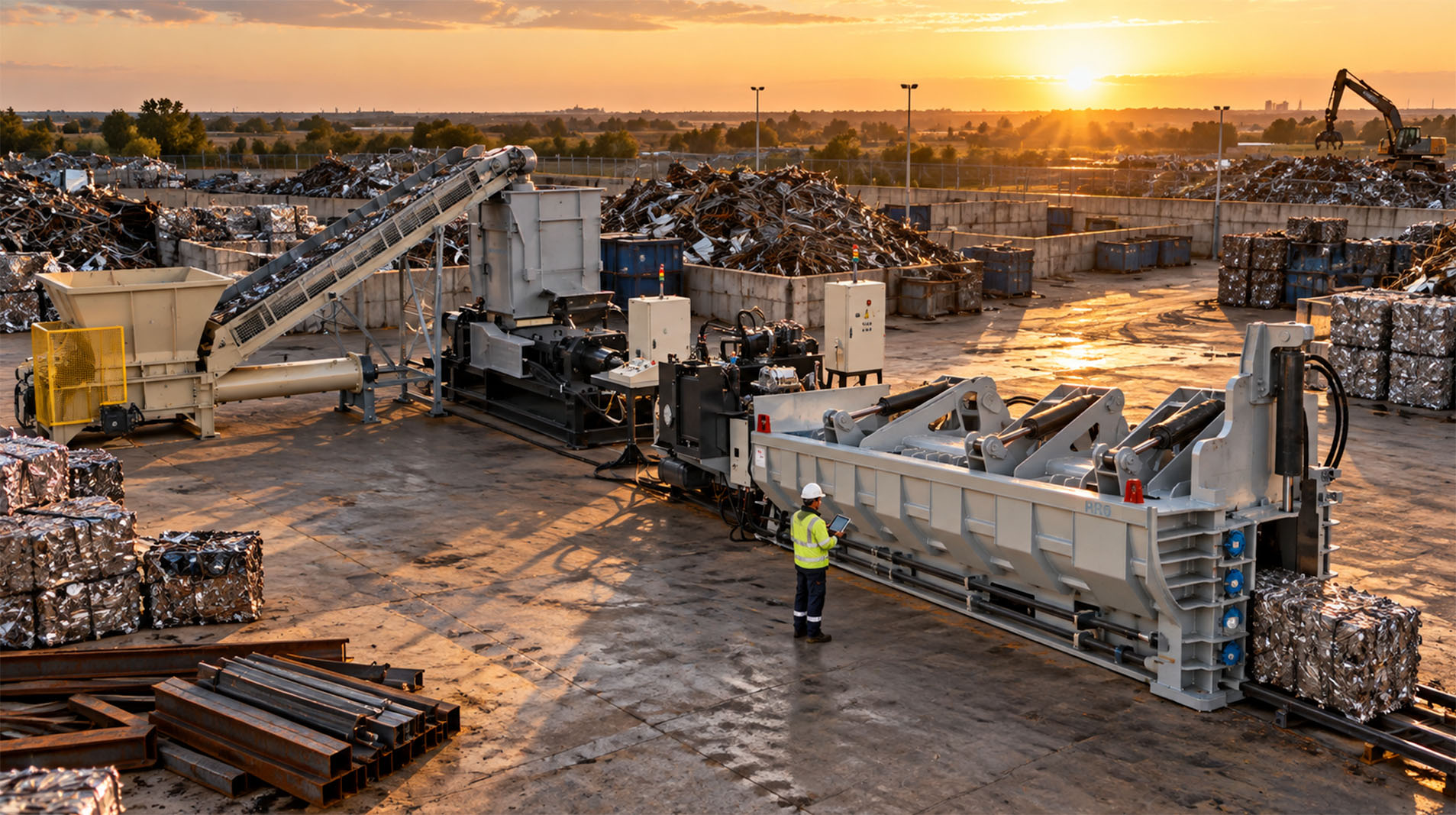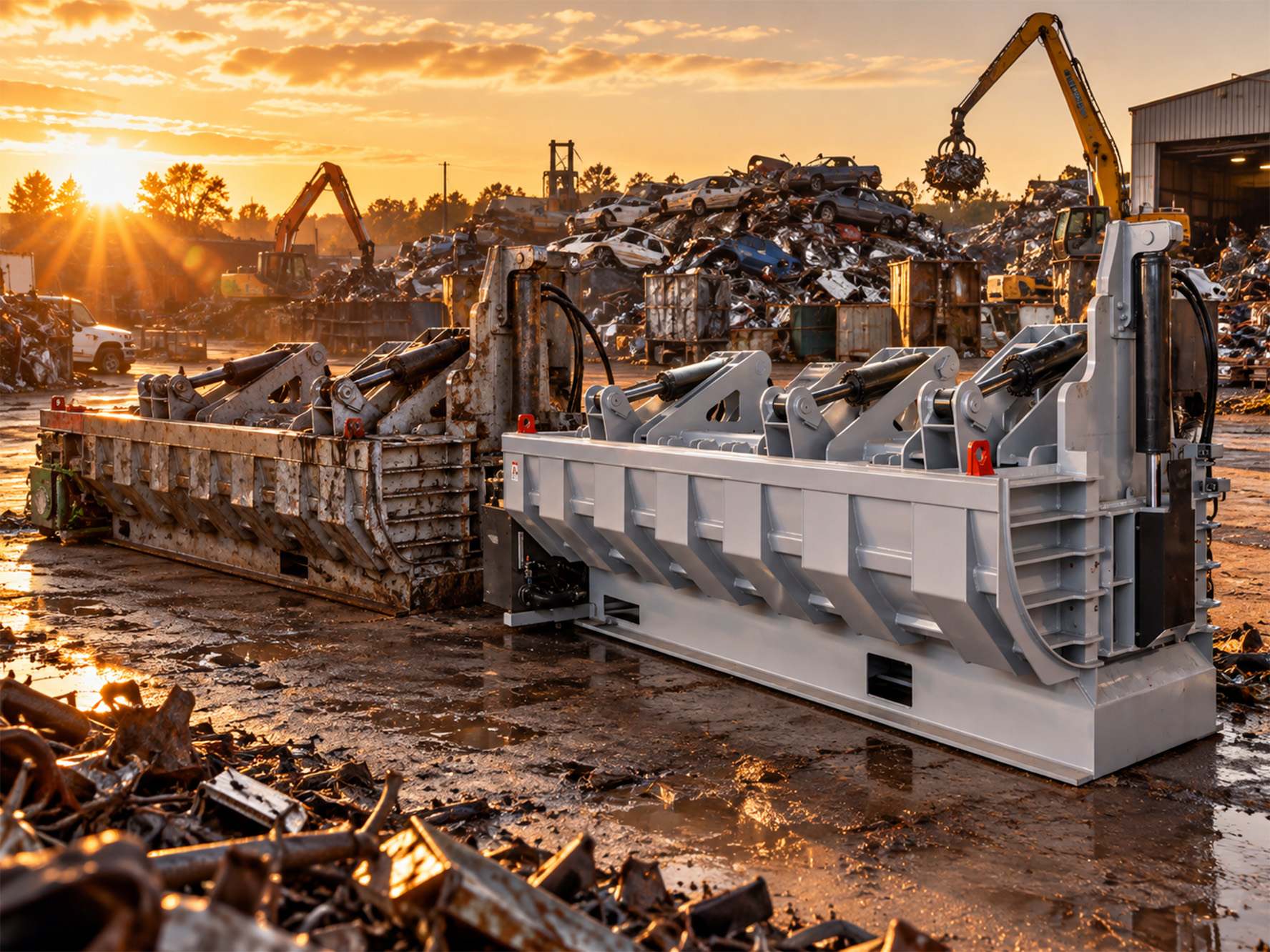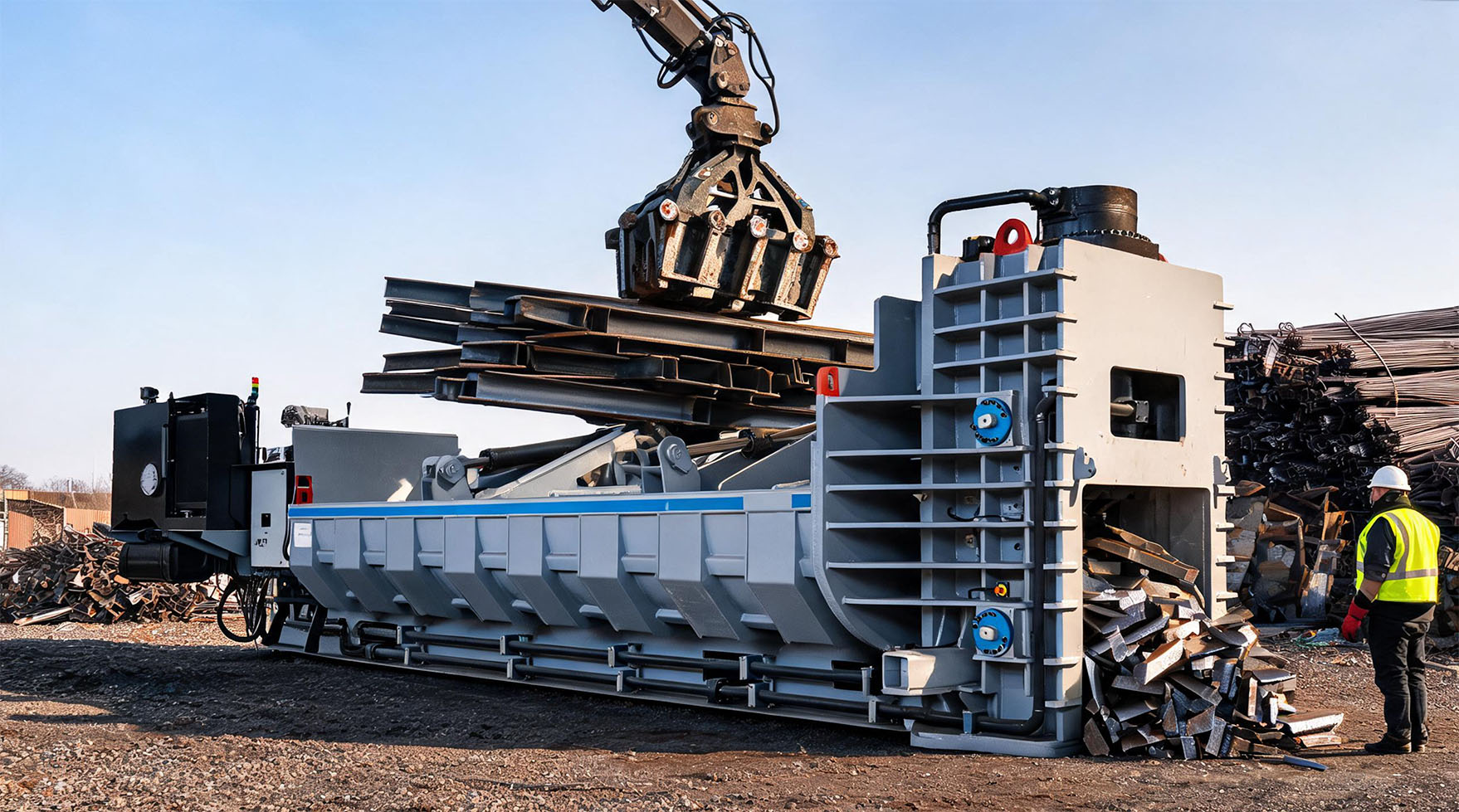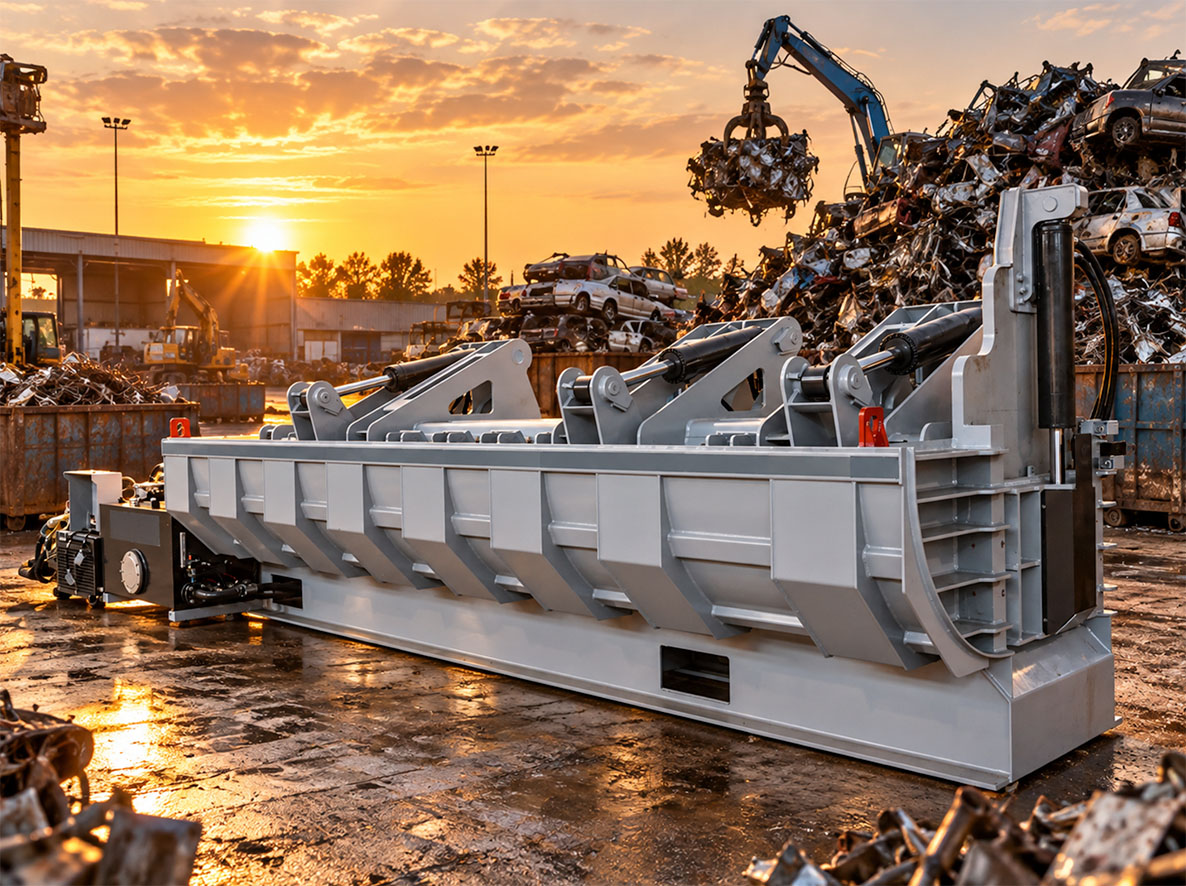
Short answer: a heavy-duty scrap baler is defined by measurable figures, not by the word on the brochure. The numbers that matter are lid force, main cylinder force, working pressure, box size and steel grade, hydraulic components and rated throughput for a named material. For the Roter RR5 and RR6 those figures are a 200 t lid force from three cylinders, a 155 t main cylinder, 280 bar working pressure, a Hardox 400/450 box, a Parker PV Plus main pump and a published capacity of 8–14 t/h on scrap metal and 15–20 t/h on vehicle scrap.
Every supplier calls its baler heavy duty. Few explain what that means in terms a buyer can verify. This guide shows how to read a baler specification sheet line by line, using the published RR5 and RR6 data as a worked example, and ends with ten questions to put to any supplier before you sign.
Why “heavy duty” needs numbers behind it
A scrap baler lives a hard life. It takes uneven, abrasive, springy material every few minutes, often outdoors, often across long shifts. A machine built to a light specification will compress well in a demonstration and then lose time to wear, overheating and repairs once it meets a real yard. The difference between the two rarely shows in photographs. It shows in the specification sheet, if you know where to look.
Roter’s engineering team in Ferrara designs the RR series around that reality, and publishes the figures so buyers can compare them. The sections below explain what each one tells you.
The four figures that define a heavy-duty baler
Lid force
Lid force tells you how hard the machine can pre-compress material before the final stroke. Bulky scrap springs back if the lid cannot hold it down, which produces loose bales and wasted cycles. On the RR5 and RR6 the lid is driven by three cylinders and delivers 200 t. Three cylinders spread that force evenly along the lid, so it closes squarely over long or uneven loads; our article three cylinders, not two explains the engineering.
Main cylinder force
The main cylinder forms the final bale and pushes it out of the box. On the RR5 and RR6 it is rated at 155 t. Compare suppliers in tonnes of force, measured the same way; a figure in horsepower, or a force with no stated cylinder, cannot be compared.
Box length and opened width
Box length sets the longest piece you can load without pre-cutting; opened width sets how easily a grapple can drop material in. The RR5 has a 5,000 mm box and the RR6 a 6,000 mm box, both with an opened width of 1,850 mm. If you handle pipe, long sections or vehicle shells, box length matters as much as force.
Box steel
The box takes more punishment than any other part of a baler. The RR5 and RR6 box is built in Hardox 400/450, a wear-resistant steel suited to the abrasion and impact of scrap. Ask every supplier which steel grade the box uses, and how worn sections are repaired or replaced over the machine’s life.
Reading the RR5 and RR6 specification line by line
The table translates each published figure into what it means on your site. Every row is a value you can measure or check, which is the point.
| Specification | RR5 / RR6 | What it tells you |
|---|---|---|
| Lid force | 200 t, three cylinders per lid | Pre-compression strength and even closing on bulky loads |
| Main cylinder | 155 t | Final compression of the bale |
| Working pressure | 280 bar | The hydraulic pressure behind those forces |
| Box | Hardox 400/450; 5,000 / 6,000 mm long; 1,850 mm opened width | Wear resistance and the size of piece you can load |
| Bale section | 880 × 650 mm | The cross-section of every bale |
| Oil circuit | 800 litres | Hydraulic volume, relevant to cooling over long shifts |
| Main pump | Parker PV Plus Series | A named, recognised hydraulic component |
| Power | 55/75 kW Perkins or CAT diesel, or 75 kW electric (90 kW option) | Grid independence or electric running costs |
| Capacity | 8–14 t/h scrap metal; 15–20 t/h vehicle scrap | Throughput for a named material |
| Weight | 21 t | Transport and set-up planning |
| Controls | 7″ or 10″ touch screen, radio control, light and sound signals | Safe operation at a distance |
| Certification | CE certified | Documentation for European supply |
When a supplier answers a question with an adjective, ask for the number. Full details are on the RR5 and RR6 product page.
Pressure, oil volume and pump: the system behind the force
A force figure only means something alongside the hydraulic system that produces it. Working pressure shows how hard the oil pushes the cylinders. Oil circuit volume and pump quality determine how consistently the machine holds that pressure through a long shift, rather than in the first hour. The RR5 and RR6 combine 280 bar with an 800-litre circuit and a Parker PV Plus Series pump.
When you read a competing specification, look for the pump make and the pressure rating. A high force figure with no stated pressure or pump is hard to verify. And because hydraulic health drives long-term uptime, read our hydraulic maintenance guide alongside any purchase decision.
Throughput: tonnes per hour, for which material?
Throughput is where claims are most often inflated. A capacity figure is meaningless without the material it applies to. The RR5 and RR6 are published at 8–14 t/h on scrap metal and 15–20 t/h on vehicle scrap. These are different jobs: car bodies are bulky and fill the box quickly, so the machine moves more tonnes per hour on vehicles.
Real output on your site also depends on loading speed, feed method and operator skill. Treat any capacity figure as a guide and confirm it in your quote against your own material. If you are still working out the size you need, start with how to size a baler for your yard’s tonnage.
Because the same machine bales end-of-life vehicles, some buyers search for it as an industrial car crusher. For that application, see our car baler page.
Ferrous scrap: the bale formats mills accept
A ferrous scrap baler works on the iron and steel scrap that mills and foundries buy, and what matters to them is the bale’s format and density. The RR5 and RR6 offer two programmes:
- Dense Bale to maximise density for storage and transport
- Bale for Mills to prepare bales to steel mill charging requirements
Check your buyer’s bale specification before choosing a programme. If you supply steel plants, read scrap metal balers for steel plants: what to look for, and see how density feeds through to freight in bale density and scrap transport economics. Bale weights for your material are confirmed in your quote.
Power, configuration and duty cycle
Diesel or electric
The RR5 and RR6 can be specified with a 55 or 75 kW Perkins or CAT diesel engine with a 90-litre tank, or a 75 kW electric motor with a 90 kW option. Diesel gives independence from the grid; electric suits sites with a strong supply and favourable energy costs.
Installation
The machines are available in stationary, semi-mobile and roll-on/roll-off configurations, with no foundation required where applicable. Choose by how often the machine will move. Our guide to semi-mobile versus fixed installation compares the options.
Duty cycle
A baler that looks strong on paper can still struggle when it runs long shifts day after day. If you plan multi-shift operation, say so in your enquiry and ask every supplier to confirm the machine’s suitability in writing. For Roter, the configuration for your duty is confirmed in your quote.
Options for demanding sites
Options on the RR5 and RR6 include a grapple with rotor (250/280/300 litres), cabin air conditioning, preheated hydraulic oil and engine for cold starts, an automatic grease system, a liquid collection tank, hydraulic lifting legs, and emergency and 2,000-hour spare-parts kits. Option prices are confirmed in your quote.
Ten questions to put to every baler supplier
- What are the lid force and main cylinder force, in tonnes?
- What is the working pressure, in bar?
- What steel grade is the box, and how are worn sections replaced?
- What is the throughput in tonnes per hour, and for which material?
- What bale section and programmes are available?
- What engine or motor power, and what fuel tank size?
- Which hydraulic components are used, and where do spare parts come from?
- Does the machine need a foundation?
- Are installation, operator training and remote diagnostics included?
- Is the machine suitable for the shift pattern you plan to run?
With Roter, on-site installation, operator training and remote diagnostics are part of the supply, and spare parts are held in stock in Ferrara. See baler spare parts and service.
Get the specification for your site
Send us your material, your tonnes per hour and your site details. Our engineers will recommend a configuration with the right power unit and options, and confirm specification, bale weights and delivery in a tailored quote.
Request a quote for a heavy-duty scrap baler
Heavy-duty scrap baler: frequently asked questions
What makes a scrap baler heavy duty?
High compression force, wear-resistant construction and proven hydraulic components, all stated as numbers. For the Roter RR5 and RR6 that means a 200 t lid force, a 155 t main cylinder, 280 bar working pressure, a Hardox 400/450 box and a Parker PV Plus pump, with 8–14 t/h capacity on scrap metal.
How much lid force do I need?
It depends on your material. Bulky or springy scrap needs more pre-compression than dense or pre-cut scrap. The RR5 and RR6 deliver 200 t of lid force from three cylinders. Share your material mix and Roter will confirm the right configuration.
What is a ferrous scrap baler?
A ferrous scrap baler compresses iron and steel scrap into bales for steel mills and foundries. The Roter RR5 and RR6 handle ferrous scrap and vehicle scrap, with Dense Bale and Bale for Mills programmes to match what the buyer wants.
How many tonnes per hour should I expect?
The published capacity of the RR5 and RR6 is 8–14 t/h on scrap metal and 15–20 t/h on vehicle scrap. Real output depends on material, loading method and operator, so the figure for your site is confirmed in your quote.
Why does Hardox matter in a baling box?
Hardox is a wear-resistant steel, so it suits the abrasion and impact scrap causes inside a baling box. The RR5 and RR6 box is built in Hardox 400/450. Ask any supplier which grade they use and how worn sections are replaced.
Specifications are taken from Roter’s published RR5/RR6 technical data. Last updated: 30 October 2026.