
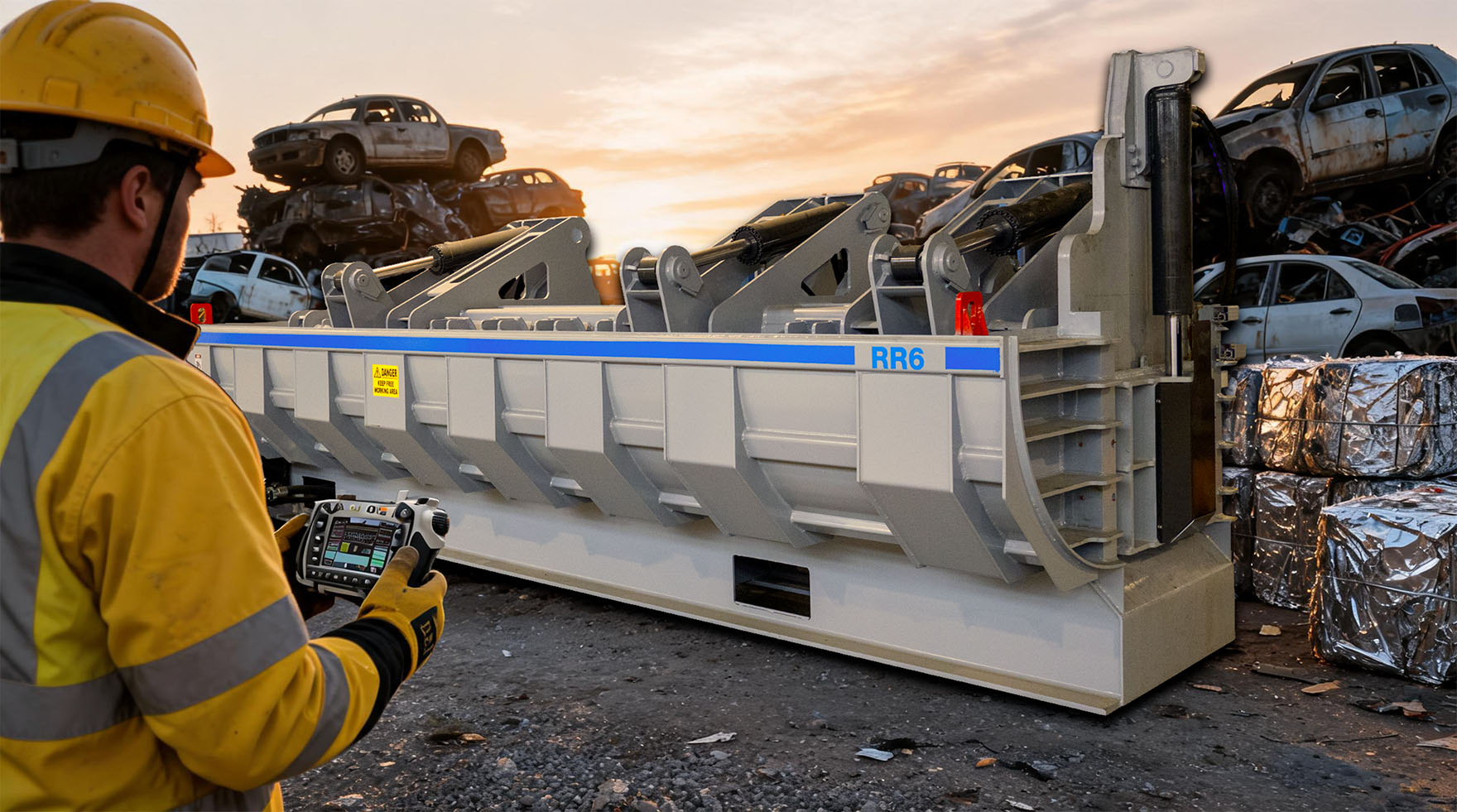
Short answer: a scrap metal baling machine is a hydraulic press that compresses loose scrap metal into dense, regular bales that are cheaper to store, transport and sell. Scrap is loaded into a steel box, a lid and a main cylinder compress it, and the finished bale is ejected for stacking. Roter designs three families of baling machine in Ferrara, Italy: the RR series baler (RR5 and RR6), the RR series shear baler (RR550 and RR715.6), and the RA Series automatic baler.
This guide is written for anyone specifying, buying or running one for the first time. It explains what a baling press does, the parts that matter, the baling cycle step by step, the working programmes, and how to choose between the three families. Every figure comes from Roter’s published technical data; anything that depends on your material is confirmed in your quote.
What a scrap metal baling machine does
Loose scrap is mostly air. It fills yards, overloads storage bays and travels at a poor weight per truck. A baling press turns it into a uniform block, and the benefits follow directly:
- Less storage space for the same tonnage
- More efficient loading onto trucks, containers or rail, and a lower transport cost per tonne
- A product mills and foundries accept, when the bale format matches their charging specification
- Safer, tidier yards, with less loose material underfoot and in the air
You will hear the same equipment called a scrap baler, a metal baling press, a scrap metal baling press or a hydraulic scrap baler. In practice the terms overlap: the working principle is the same, and the differences come from the specific model. Our scrap metal baler page covers the full range, and bale density and scrap transport economics shows how the numbers add up.
Anatomy of a baling press
The RR5 and RR6 are a good reference point, because their architecture is shared across Roter’s RR series. Four systems do the work.
The baling box
The box holds the scrap while it is compressed, and it takes the most punishment in the machine. On the RR5 and RR6 it is built in Hardox 400/450, a wear-resistant steel suited to the abrasion and impact that scrap causes. Box length is 5,000 mm on the RR5 and 6,000 mm on the RR6, with an opened box width of 1,850 mm. Box length sets the longest piece you can load without pre-cutting.
The lid and its three cylinders
The lid closes over the box and pre-compresses the load. On the RR5 and RR6 it is driven by three cylinders per lid, producing a lid force of 200 t. Three cylinders spread the load along the lid, so it closes evenly over long or uneven material rather than twisting under it. Our article three cylinders, not two explains the engineering behind that choice.
The main cylinder
The main cylinder delivers the final compression and pushes the finished bale out of the box. On the RR5 and RR6 it is rated at 155 t, producing a bale with an 880 × 650 mm section.
Pump and power unit
The hydraulic system converts engine or motor power into pressure. The RR5 and RR6 use a Parker PV Plus Series main pump, an 800-litre oil circuit and a working pressure of 280 bar. Power comes from a 55 or 75 kW Perkins or CAT diesel engine (with a 90-litre diesel tank) or a 75 kW electric motor, with a 90 kW electric motor available as an option.
The baling cycle, step by step
1. Load
Scrap is fed into the open box by grapple, crane or loader. On the RR5 and RR6, a grapple with rotor (250, 280 or 300 litres) is available as an option. The operator runs the machine with the radio control included as standard, or from the 7″ or 10″ touch screen.
2. Close and compress
The lid closes and its three cylinders pre-compress the material. The main cylinder then applies the final force to form the bale. The selected programme governs how the machine compresses, depending on the bale you want.
3. Eject
The bale is pushed out of the box, ready for stacking and transport. The box reopens and the cycle repeats. Cycle time and bale weight depend on the material and are confirmed in your quote; as a guide, Roter rates the RR5 and RR6 at 8–14 t/h on scrap metal and 15–20 t/h on vehicle scrap.
Working programmes: Dense Bale or Bale for Mills
The RR5 and RR6 offer two programmes, so one machine can serve different buyers:
| Programme | Intended for |
|---|---|
| Dense Bale | Compact, heavy bales that maximise density for storage and transport |
| Bale for Mills | Bales prepared to suit steel mill charging requirements |
The right choice depends on who buys your scrap. Ask the mill or foundry for its bale requirements first, then set the programme to match.
The RR series shear balers add two more: Shear and Shear with Pre-compression. These let the machine cut long or oversized steel into pre-sized pieces, either directly or after compressing it first, for four programmes in total.
Why hydraulic
Modern scrap balers are almost all hydraulic. Oil under pressure moves the cylinders, giving smooth, controllable force that can be set by programme, and a single pump and power unit can drive the lid, the main cylinder and, on shear models, the shear itself. For a full comparison with older designs, read hydraulic vs mechanical balers: the engineer’s verdict.
Hydraulic capacity scales with the work. The RR5 and RR6 run at 280 bar with an 800-litre oil circuit. The RR715.6 shear baler runs at 280/320 bar with a 1,600-litre circuit to deliver its far higher shear force. Keeping that system healthy is the single biggest factor in long-term uptime; our hydraulic maintenance guide covers the routine.
Three machine families compared
Roter builds three families, each designed for a different material and a different flow.
| RR series baler (RR5 / RR6) | RR series shear baler (RR550.5 / RR550.6 / RR715.6) | RA Series automatic baler (RA70.1 to RA140.2XL) | |
|---|---|---|---|
| Typical use | Bulky and mixed scrap metal, vehicle scrap | Long, heavy or irregular steel that needs cutting | Continuous flows of industrial scrap in plants and manufacturing sites |
| Force | 200 t lid, 155 t main cylinder | 550 t or 715 t shear, 120 t hold-down | 70–140 t cutting force |
| Bale section | 880 × 650 mm | 880 × 650 mm, or cut pieces | 220 × 220 mm to 400 × 300 mm |
| Output | 8–14 t/h scrap metal, 15–20 t/h vehicle scrap | 3.5 cuts per minute (dry cycle) | Up to 100 bales/h; up to 6 t/h depending on material and feeding |
| Power | 55/75 kW diesel or 75 kW electric (90 kW option) | 225 hp / 168 kW diesel | 18.5–45 kW electric |
| Programmes | Dense Bale, Bale for Mills | Dense Bale, Bale for Mills, Shear, Shear with Pre-compression | Automatic cycle for continuous feeding |
| Installation | Stationary, semi-mobile or roll-on/roll-off; no foundation where applicable | Semi-mobile, no foundation | Civil works confirmed by configuration |
Explore each family in more depth: the RR5 and RR6 baler, the RR715.6 shear baler and the RA Series automatic baler guide.
Controls and diagnostics
Modern balers are operated from a safe distance and monitor their own condition. The RR5, RR6 and RR series shear balers come with radio control, a 7″ or 10″ touch screen, and a light and sound signal system. On the shear balers, alarm auto-diagnostics with guided procedures, a surge-protected PLC and a safety engine auto-stop are part of the design. The RA Series uses a Siemens PLC with a 5″ touch screen and cylinders with linear position transducers, so each automatic cycle is measured rather than estimated.
Behind the controls sits Roter’s service model: on-site installation and commissioning, operator training, remote diagnostics and spare parts supplied from Ferrara. See baler spare parts and service.
Options that fit the machine to your yard
Options turn a standard machine into one that fits your site, material and climate. On the RR5 and RR6 they include:
- Grapple with rotor (250/280/300 litres) for loading
- 90 kW electric motor
- Cabin air conditioner
- Preheated hydraulic oil and preheated engine for cold-weather starts
- Automatic grease system for lubrication points
- Liquid collection tank, useful on vehicle scrap
- Emergency spare-parts kit and customised colour
The RA Series is configured around its feeding and integration points, with customised loading hoppers and exit chutes, and options such as a weighing system. Option prices are confirmed in your quote.
Choosing the right baling machine
Start with the material, then work outwards:
- What do you process? Bulky mixed scrap and end-of-life vehicles point to an RR series baler. Long or heavy steel that needs cutting points to a shear baler. A continuous flow of production scrap inside a plant points to an RA Series automatic baler.
- How much, and how often? Compare your daily tonnage with the output figures above.
- Where will it work? Stationary, semi-mobile or roll-on/roll-off, and whether the site suits a diesel or an electric machine.
- What does your buyer accept? Match the bale format and programme to the mill specification.
The decision matrix for recycling yards and our guide to which baler for which scrap take you through this in more detail. If you would rather talk it through, our engineers will recommend a configuration.
Request a quote for a scrap metal baling machine
Scrap metal baling machine: frequently asked questions
How does a scrap metal baling machine work?
Loose metal is loaded into a steel box. A lid closes and pre-compresses it, then a main cylinder applies the final force to form a dense bale, which is ejected before the cycle repeats. A hydraulic pump driven by a diesel engine or electric motor supplies the force.
What is the difference between a baler and a baling press?
In scrap recycling the two names are used interchangeably. Both describe a hydraulic machine that compresses loose metal into bales. Real differences come from the model: its force, box size, power unit, programmes and whether it includes a shear.
What bale sizes can a Roter baler produce?
The RR5, RR6 and RR series shear balers produce bales with an 880 × 650 mm section. The RA Series automatic balers produce smaller bales, from 220 × 220 mm to 400 × 300 mm depending on the model. Bale weight depends on the material and is confirmed in your quote.
How much force does a scrap baler use?
It depends on the machine. The RR5 and RR6 have a 200 t lid force and a 155 t main cylinder. The RR series shear balers have 550 t or 715 t of shear force with a 120 t hold-down. The RA Series automatic balers have 70–140 t of cutting force.
Does a scrap baler need a foundation?
Not always. The RR5 and RR6 can be installed without a foundation where applicable, in stationary, semi-mobile or roll-on/roll-off configurations. The RR series shear balers are semi-mobile and need no foundation. Civil works for RA Series installations are confirmed by configuration.
How often does a hydraulic baler need servicing?
Service intervals depend on operating hours, material and conditions, so follow the schedule set for your machine. Roter supplies spare parts from Ferrara, including a 2,000-hour spare-parts kit for the RR5 and RR6, and supports customers with remote diagnostics.
Specifications are taken from Roter’s published RR, RR shear and RA Series technical data. Last updated: 22 October 2026.
