
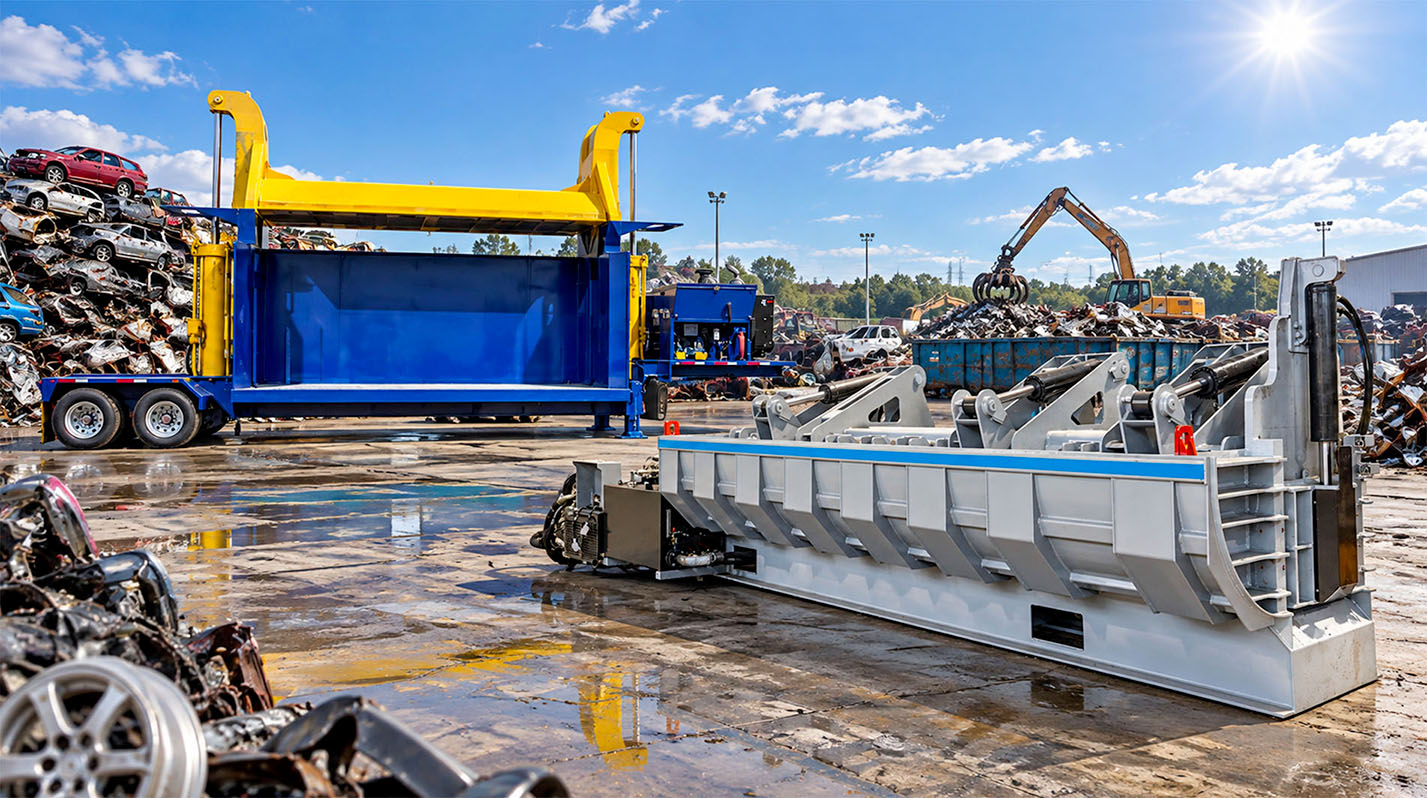
Short answer: a car flattener presses an end-of-life vehicle flat so it is easier to stack and move. A car baler compresses vehicles in a closed box into dense, regular bales that load, ship and sell more efficiently. If you process a modest number of cars and sell to a local buyer who collects flattened hulks, a flattener can be enough. If you pay for freight, sell to steel mills or also handle other scrap, a car baler such as the Roter RR5 or RR6, rated at 15–20 t/h on vehicle scrap, usually earns its place.
Yards searching for a car flattener for sale are often asking a bigger question: which machine turns end-of-life vehicles into something a buyer will pay the most for, at the lowest cost per tonne shipped? This guide sets out the difference, compares the two side by side, and lists the questions to settle with your scrap buyer before you spend anything. For an overview of the machine types, see our car crusher page.
Flattener, logger or baler: the difference in brief
A flattener lowers a car’s height by pressing down on it from above; the trade often calls it a car crusher. A logger compresses from the sides as well, producing a log-shaped output. A baler compresses the vehicle in a closed box from several directions and ejects a dense, regular bale. Terminology varies from country to country, so always ask what output a machine produces rather than relying on its name.
Side by side: car flattener vs car baler
| Factor | Car flattener | Car baler |
|---|---|---|
| Output | A flat vehicle, still bulky and irregular | A dense, regular bale |
| Trucking | Flattened hulks keep voids and uneven edges, so each load carries less steel | Uniform bales pack tightly, within the buyer’s and haulier’s weight limits |
| Storage | Stacks flat and saves space compared with whole cars | Stacks in neat, stable blocks |
| Buyer acceptance | Varies; some buyers require further processing | Bales are a standard input for many mills; check your buyer’s specification |
| Throughput | Depends on the specific machine | RR5/RR6: 15–20 t/h on vehicle scrap |
| Other scrap | Usually vehicles only | RR5/RR6 also bale general scrap metal at 8–14 t/h |
| Price | Confirmed by each supplier | Confirmed in your quote |
The comparison is general except for the Roter figures, which come from the published RR5/RR6 specification. Flattener performance varies by manufacturer.
When a flattener is enough
A flattener can be the right tool if you:
- Handle a modest, irregular number of vehicles
- Sell to a nearby buyer who collects flattened cars and accepts them as they are
- Have no plans to process other scrap with the same machine
When a flattener starts to cost you
The economics change when you:
- Pay for transport, because every load leaves with less steel than it could carry
- Are asked by your buyer for a denser or more regular product
- Want one machine to handle mixed scrap as well as vehicles
- Are short of yard space and need stable, uniform stacks
Freight is the hidden number. A cheaper machine that sends less steel on every truck can lose its price advantage over a season of loads. Our guide to bale density and scrap transport economics shows how density feeds through to cost per tonne, and how balers reduce transport emissions covers the environmental side.
Why many yards move up to a car baler
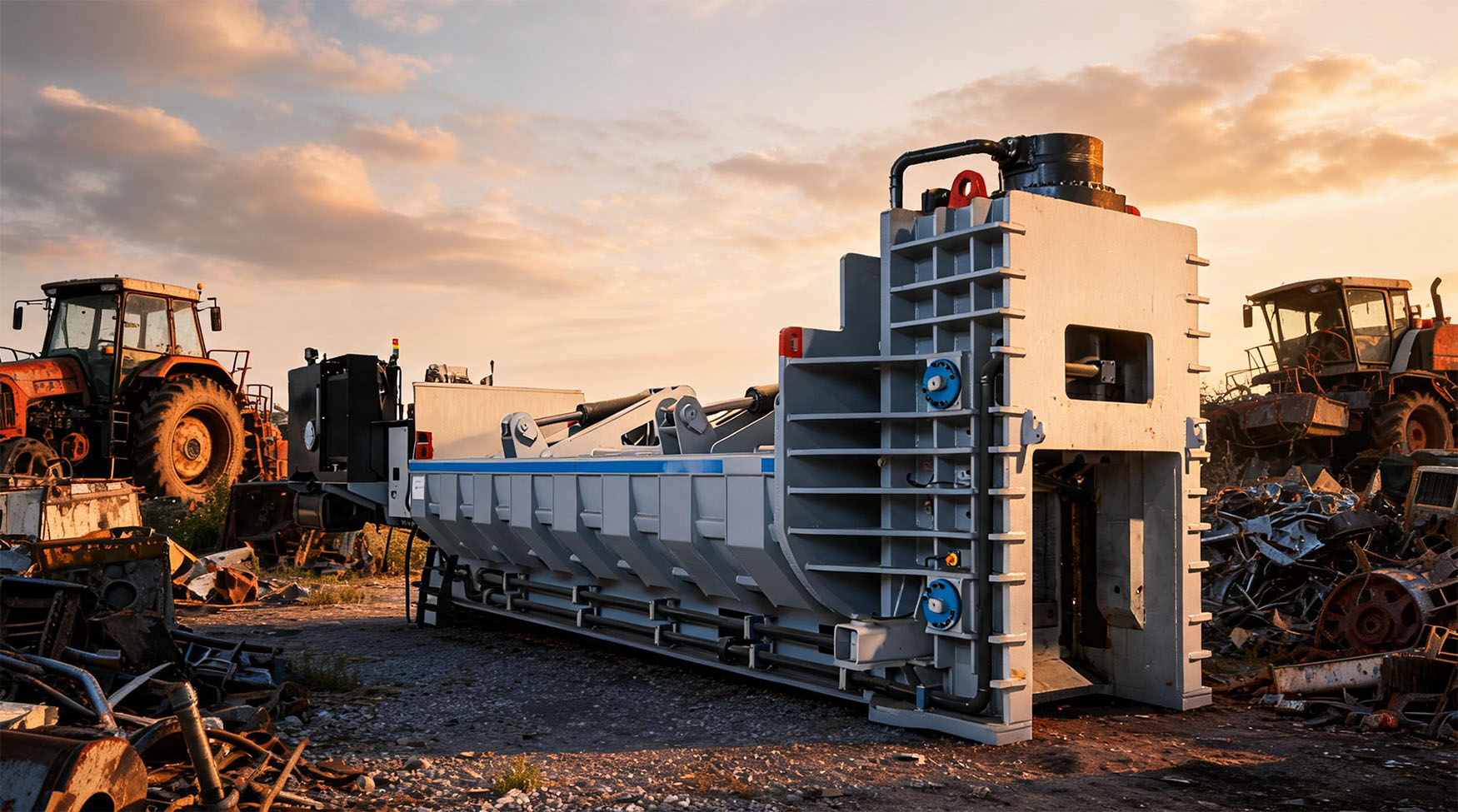
Roter built its car baler range, the RR5 and RR6, for automotive recyclers who want one robust machine for vehicles and general scrap, designed and assembled in Italy and supported for its whole working life:
- Even compression: three cylinders per lid deliver 200 t of lid force, with a 155 t main cylinder. Read three cylinders, not two for the engineering.
- Capacity: 15–20 t/h on vehicle scrap and 8–14 t/h on other scrap metal
- Box and bale: a Hardox 400/450 box of 5,000 mm (RR5) or 6,000 mm (RR6) producing an 880 × 650 mm bale
- Two programmes: Dense Bale and Bale for Mills, so the same machine can serve different buyers
- Flexible installation: stationary, semi-mobile or roll-on/roll-off, with no foundation required where applicable
- ELV-ready options: a liquid collection tank, a grapple with rotor and cabin air conditioning
- Support: on-site installation, operator training, remote diagnostics and spare parts supplied from Ferrara
Full specifications are on the RR5/RR6 product page. For yards that move between sites, see the mobile car baler page, and read no foundation, no compromise on baling vehicles without civil works.
Questions to ask your scrap buyer first
Before you buy any machine, ask the company that takes your output:
- What size and weight of bale, or flattened car, do you accept?
- Is there a density requirement, and do you pay more for denser material?
- Do you accept flattened cars, or only baled or processed material?
- How is transport charged: by weight or by load?
- What depollution and dismantling must be done before the vehicle is processed?
The answers decide which machine earns its money. For the full automotive picture, read choosing the right baler for automotive recycling and our automotive and ELV applications.
Request a car baler quote
Not sure whether a flattener or a baler suits your yard? Tell us your vehicle volumes, your buyer’s requirements and your site, and our engineers will recommend a configuration and send a tailored quote.
Request a quote for the RR5/RR6 car baler
Car flattener vs car baler: frequently asked questions
What does a car flattener do?
A car flattener presses a vehicle down to reduce its height so it is easier to store, stack and move. It does not produce a dense, regular block. The result is a flat but still bulky hulk, which limits how much steel fits on each truck.
Is a car flattener cheaper than a car baler?
Flatteners are generally simpler machines, but prices vary by supplier and specification. Compare the total cost per tonne shipped, not just the purchase price. Roter does not publish list prices; the price of a baler is confirmed in your quote.
Which puts more steel on a truck?
Dense, regular bales generally load more efficiently than flattened vehicles, which keep voids and irregular edges. Actual payload depends on your buyer’s weight limits and the transport used, so ask your haulier to compare both on your route.
Do steel mills accept flattened cars?
It depends on the buyer. Some accept flattened vehicles; others specify baled or processed material. Get the requirements in writing before you buy a machine. The RR5 and RR6 include a Bale for Mills programme for buyers with specific bale requirements.
Can a car baler handle other scrap too?
Yes. The RR5 and RR6 bale vehicles at 15–20 t/h and general scrap metal at 8–14 t/h, so one machine can serve both streams. A flattener is normally limited to vehicles.
Roter specifications are taken from the published RR5/RR6 technical data. Last updated: 30 October 2026.
What do you think?
[…] See automotive and ELV, the car baler and car crusher pages, and car flattener vs car baler […]