
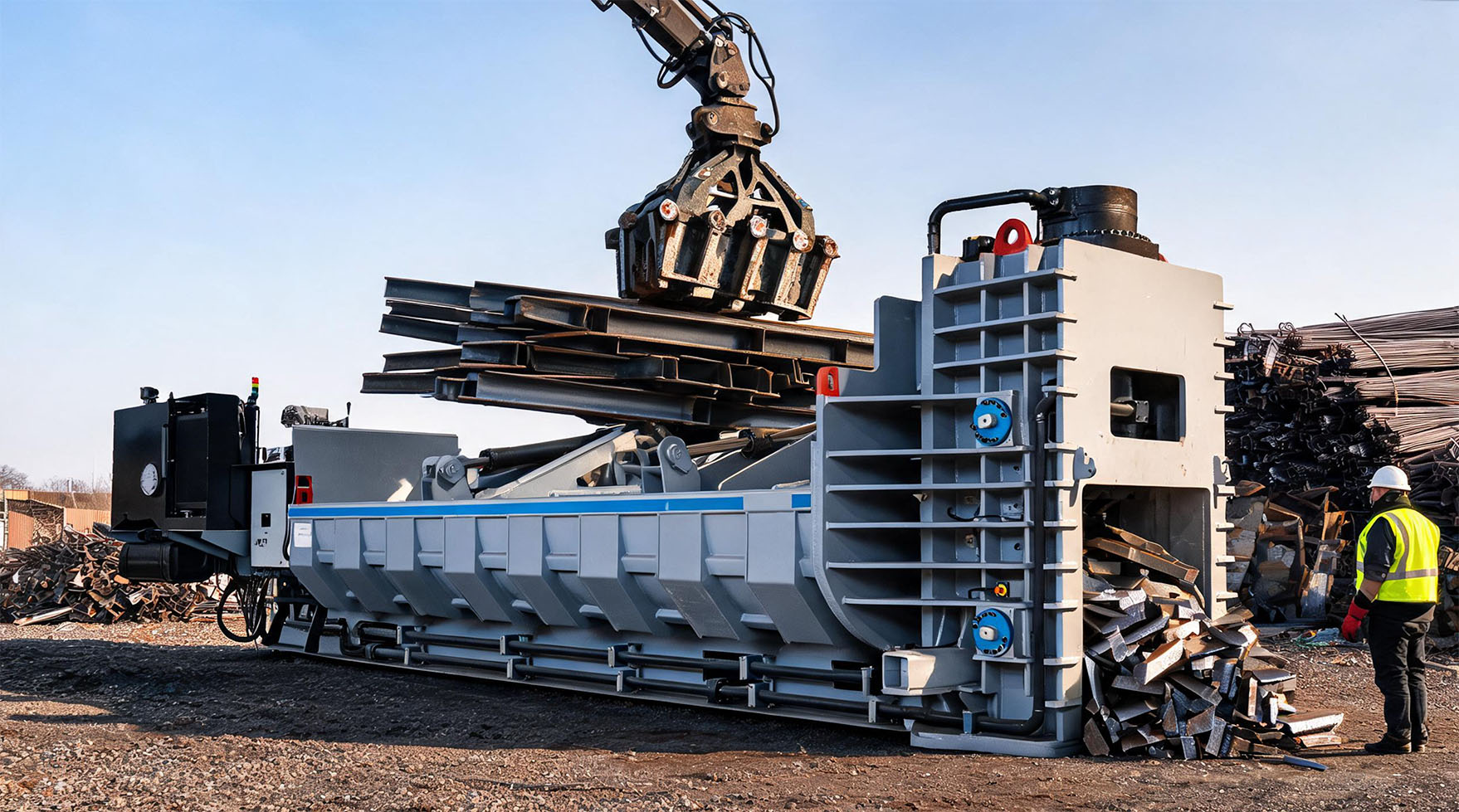
Short answer: there is no single shear baler price. The cost of a shear baler depends on its shear force class, box length, power unit, the options you add and the support that comes with it. Roter configures every RR series shear baler (the 550 t RR550.5 and RR550.6, and the 715 t RR715.6) to the buyer’s material, site and daily tonnage, so the price is confirmed in a tailored quote after a technical review. Roter does not publish a price list, and this guide does not quote figures.
What it does give you is the logic behind the number: what moves the price of a shear baler, what should already sit inside the quote, which options change it most, and how to compare offers from different suppliers fairly. For pricing across all machine types, including balers and automatic balers, see our scrap baler price page. This article focuses on the shear baler range.
Why a shear baler sits in a different price class
A shear baler is a baling press with a heavy shear built in. It compresses bulky scrap in its box, then either cuts the compacted material into pre-sized pieces or discharges it as a dense bale. That second system, the shear, its blade and the hold-down that clamps the material during each cut, is what places a shear baler in a different class from a standard baler.
The investment is justified by what it replaces. Without a shear baler, long and heavy scrap needs a separate cutting step (torch, alligator shear or a dedicated machine) before it can be baled or sold. Roter built the RR series around removing that step: one transportable machine, heavy enough for demolition steel and structural sections, that cuts or bales depending on what the buyer wants. Each one is assembled and tested at Roter’s plant in Limidi di Soliera before delivery.
The specification choices that move the price
Two shear balers that look alike in a brochure can sit far apart in price. Within the Roter range, three specification choices account for most of the difference.
Shear force class: 550 t or 715 t
The range offers two shear classes. The RR550.5 and RR550.6 deliver 550 t of shear force; the RR715.6 delivers 715 t. More shear force means more headroom on thick sections, dense plate and tougher grades. If your incoming scrap is mostly mid-range structural steel, the 550 t class may be all you need. If heavy sections arrive every week, the 715 t class protects throughput. Specify by your heaviest regular material, not your average load and not the biggest number on the datasheet.
Box length: 5 m or 6 m
The RR550.5 has a 5,000 mm Hardox box; the RR550.6 and RR715.6 have a 6,000 mm box. A longer box accepts longer pieces without pre-cutting and makes crane loading more forgiving, but it also adds steel and length to the machine. The deciding question is simple: what is the longest piece you receive on a normal day?
Weight and transport
The three models weigh 42 t (RR550.5), 44 t (RR550.6) and 45 t (RR715.6). Weight is a consequence of the specification rather than a separate choice, but it shapes haulage, lifting on arrival and permits on the route, all of which belong in your budget. Share your site access and route when you request a quote.
| Model | Shear force | Hold-down force | Box length | Weight |
|---|---|---|---|---|
| RR550.5 | 550 t | 120 t | 5,000 mm | 42 t |
| RR550.6 | 550 t | 120 t | 6,000 mm | 44 t |
| RR715.6 | 715 t | 120 t | 6,000 mm | 45 t |
What sits inside the quote as standard
When you compare offers, check that each of the following is included rather than listed as an extra. On every Roter RR series shear baler, they are part of the machine:
- Four working programmes: Dense Bale, Bale for Mills, Shear, and Shear with Pre-compression
- Power unit: 225 hp / 168 kW Perkins or CAT diesel engine driving a Parker PV Plus Series main pump
- Controls: 7″ or 10″ touch-screen display, radio remote control, and a light and sound signal system
- Shear and box: 120 t hold-down, 3.5 cuts per minute (dry cycle), 150 mm minimum cutting length, Hardox box with three cylinders per lid, 200 t lid force and a 155 t main cylinder
- Reliability features: automatic lubrication of shear and hold-down, alarm auto-diagnostics with guided procedures, a PLC protected by a stabilised power supply, and a safety engine auto-stop
- Semi-mobile design: no foundation required, ready to work in a few hours once on site
- Service: on-site installation and commissioning, operator and maintenance training, and remote diagnostics
A quote that leaves out controls, lubrication, installation or training may look lower on paper, but those costs reappear later, usually at the least convenient moment.
Options that change the price
Options are where two quotes for the “same” shear baler start to diverge. The published options for the RR series are:
| Option | What it does for you |
|---|---|
| Hydraulic lifting legs (LL) | Easier positioning and set-up, useful if the machine moves between sites |
| Preloading (PT) | Stages and feeds bulky material into the box |
| Preheated hydraulic oil (OH) | Reliable hydraulic performance from cold starts |
| Preheated engine (EH) | Easier engine starts in cold climates |
| Emergency spare-parts kit (KE) | Critical parts kept on site to protect uptime |
| Customised colour (CCL) | Machine finished in your fleet or corporate colour |
Option prices are confirmed in your quote. The more useful question is not “how low is the base price?” but “what will this machine need to work every day on my site?” A yard in northern Europe that runs through winter has different priorities from one that relocates the machine between demolition projects. Remember that feeding equipment, such as a crane or an excavator with a grapple, is part of the working system: if you already own one sized for a 6-metre box, that capacity is already in your budget.
Costs you avoid: foundation and long commissioning
Because the RR series is semi-mobile and needs no foundation, the civil works a fixed shear baler requires (excavation, concrete, curing time and often a permit) do not appear in your budget. Roter states the machine is ready to work in only a few hours after arrival, so it starts earning while a foundation-mounted machine would still be waiting for concrete to cure.
The size of that saving depends on your ground, local construction costs and permitting, so no single figure applies. When you compare a Roter quote against a fixed machine, add the foundation, the civil works and the extra commissioning time to the other offer. You still need a level, stable, prepared area; our site preparation checklist covers what to check, and our guide to semi-mobile versus fixed baler installation compares the two approaches in detail.
Total cost of ownership: fuel, wear, service and uptime
Purchase price is only the first line of what a shear baler costs to own. A shear baler works under the highest loads in the yard, and its value depends on how much of the year it spends cutting. Ask every supplier about:
- Fuel: the RR series runs on a 168 kW diesel engine with a 250-litre tank, so it does not depend on a heavy electrical connection. Consumption at your duty cycle is confirmed in your quote.
- Wear parts: blade and box wear depend on how abrasive your scrap is. Ask which parts are replaceable and how quickly they are supplied.
- Service and spare parts: Roter holds spare parts in stock and supplies them from Ferrara, with on-site technical assistance when a visit is needed. See baler spare parts and service.
- Uptime: remote diagnostics and guided alarm procedures trace many faults without waiting for a technician. Read how after-sales support protects baler uptime.
- Financing: if you plan to spread the investment, compare the options in our guide to buying, leasing or finance-leasing a baler.
For a structured way to weigh purchase price against operating cost, use our guide to scrap baler ROI, payback and total cost of ownership.
How to compare shear baler quotes like for like
Whether you are looking at a new shear baler for sale or a used one, a lower price only means something if both quotes describe the same machine and the same supply. Send every supplier the same brief, then check each offer against this list:
- Shear force and hold-down force
- Box length, opened width and box material
- Engine make, power and main pump
- Controls, display and remote control
- Working programmes included
- Options, listed line by line
- Foundation and civil works required, or not
- Installation, commissioning and operator training
- Spare-parts supply, remote diagnostics and on-site assistance
- Delivery terms and lead time
For a deeper procurement checklist, read the scrap metal shear baler buyer’s guide and shear balers for scrap yards: key buying criteria. If you are still deciding whether you need cutting at all, start with scrap baler vs shear baler.
Request a shear baler quote
Tell us your material, your daily tonnage, your site access and how you load. Our engineers will recommend the right model, 550 t or 715 t, 5 m or 6 m box, with the options your operation needs, and send a tailored quote covering price, configuration and delivery. The full specification is on our shear baler page and the RR715.6 technical data page.
Request a quote for a Roter shear baler
Shear baler price: frequently asked questions
How much does a shear baler cost?
There is no single figure. The price depends on shear force class, box length, options, transport and support. Roter configures each RR series shear baler to the buyer’s material, site and tonnage, and confirms the price in a tailored quote after a technical review.
What is the difference between the RR550 and the RR715.6?
The RR550.5 and RR550.6 have 550 t of shear force; the RR715.6 has 715 t. All three share a 120 t hold-down, 3.5 cuts per minute and a 150 mm minimum cutting length. The RR550.5 has a 5,000 mm box; the RR550.6 and RR715.6 have a 6,000 mm box.
Is installation included in the price?
Yes. On-site installation and commissioning, operator and maintenance training and remote diagnostics are part of the Roter supply. The RR series is semi-mobile, needs no foundation and is ready to work in a few hours once on site.
Which options affect the price most?
The published options are hydraulic lifting legs, preloading, preheated hydraulic oil, a preheated engine, an emergency spare-parts kit and a customised colour. Which ones matter depends on how you load, where the machine works and how often it moves. Option prices are confirmed in your quote.
Does a shear baler need a foundation, and does that affect cost?
Fixed shear balers normally need a concrete foundation, which adds civil works, curing time and often permits. The Roter RR series is semi-mobile and needs no foundation, so those costs fall away. You still need a level, stable, prepared area.
Is a shear baler worth it compared with a baler?
A shear baler earns its price when you handle long, heavy or bulky steel that a standard baler cannot take without pre-cutting, or when your buyer wants cut scrap. If your material is mostly light or already sized, a baler or automatic baler may be the better investment.
Specifications are taken from Roter’s published RR550/715 technical data. Last updated: 22 October 2026.
What do you think?
[…] Be cautious with very low prices from imported low-cost machines: they are rarely comparable like-for-like once steel quality, conformity documentation, spares and service are accounted for. For a deeper walkthrough, read what drives scrap baler price and, for cutting machines, shear baler price. […]