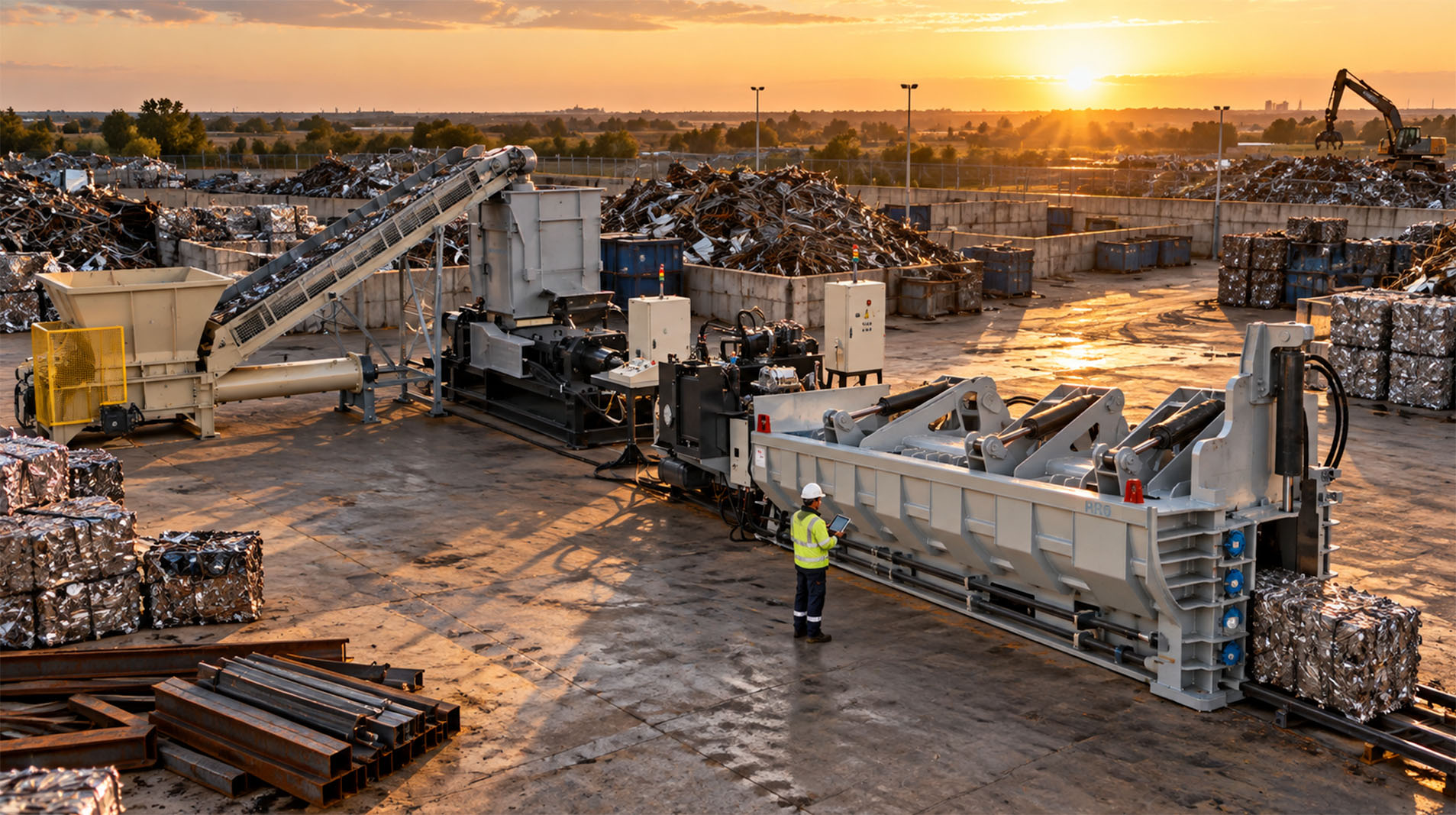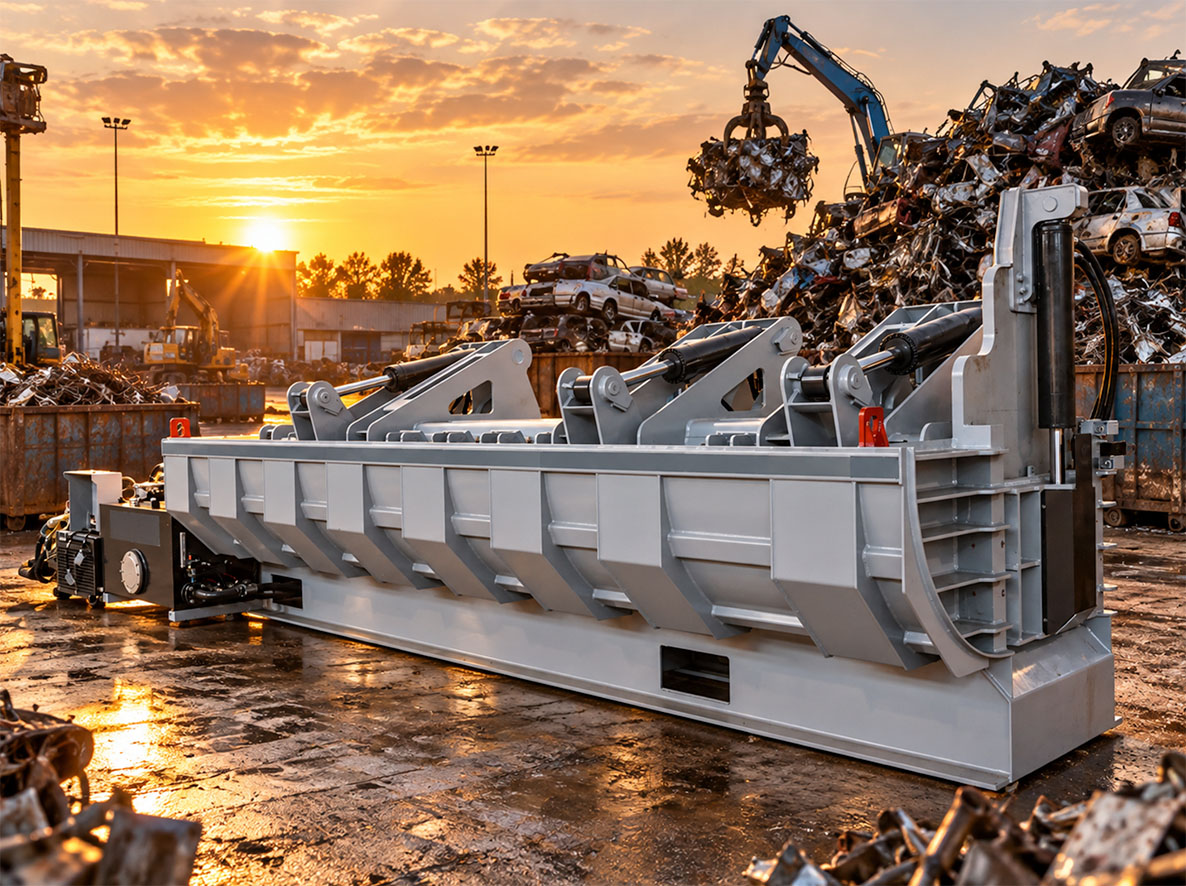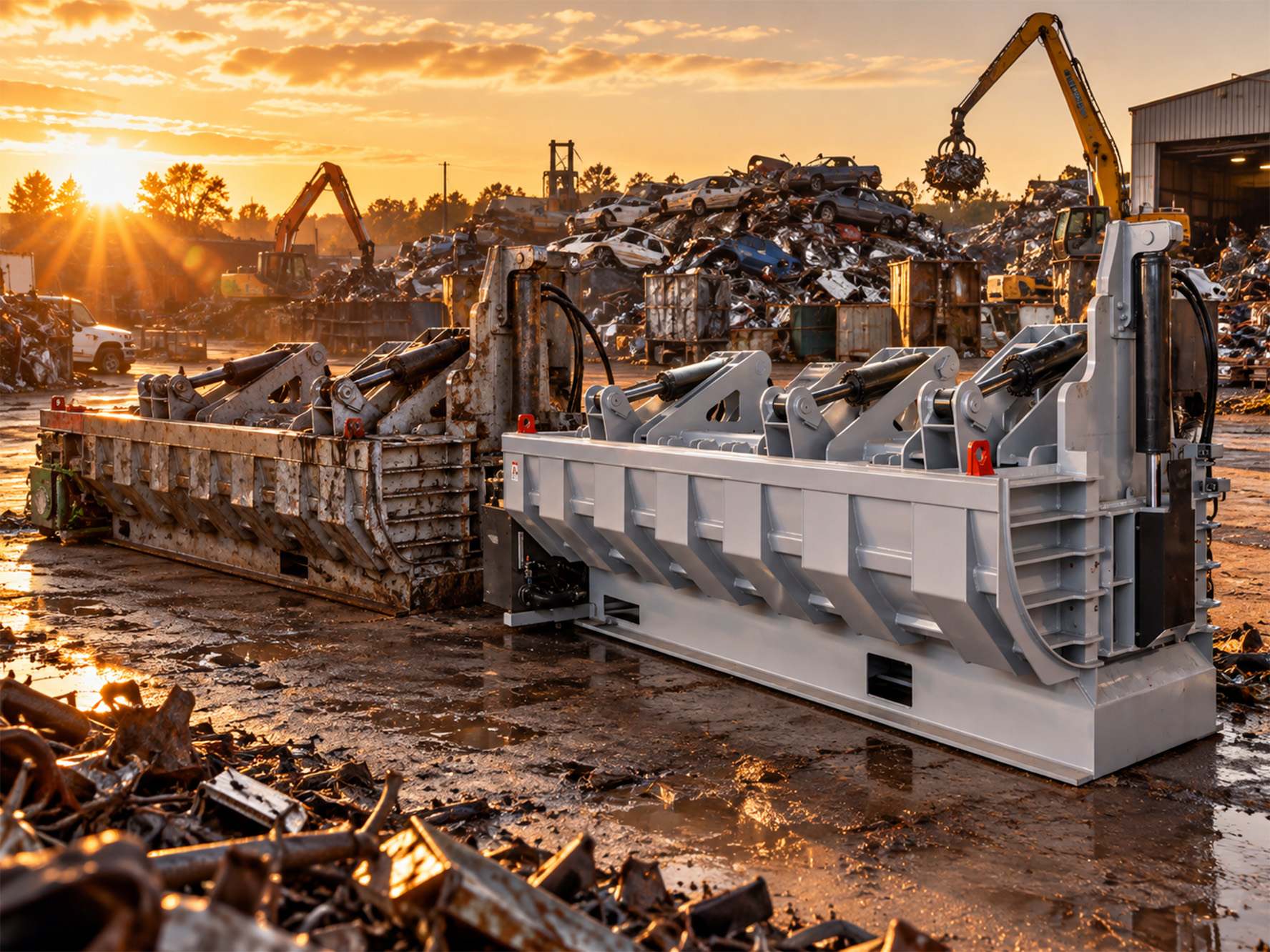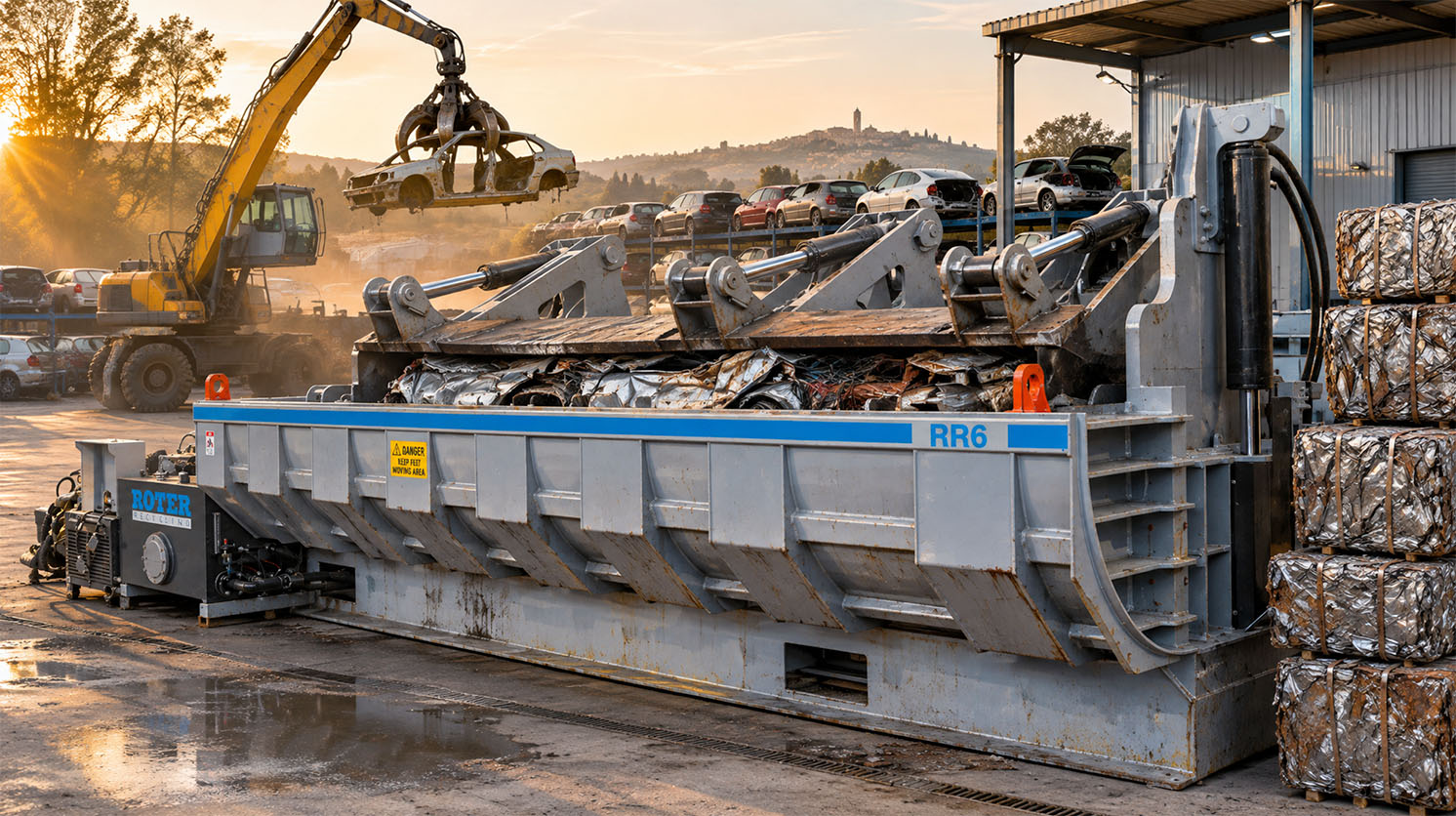
Short answer: a press baler (also called a baler press or scrap metal baler) is a hydraulic machine that compresses loose scrap metal into dense, regular bales that are cheaper to store, load and ship, and that steel mills accept as furnace feed. The right machine for a scrap yard or end-of-life vehicle (ELV) recycler depends on four facts: the scrap it processes, the tonnes it moves per day, what its site can provide, and the bale its buyer pays for. Roter Recycling builds three machine families for this work: the RR5/RR6 baler for car bodies and mixed ferrous scrap, the RR series shear baler for long, heavy steel, and the RA Series automatic baler for continuous industrial scrap.
In scrap metal, the press baler is where value is created. A yard can collect thousands of tonnes of car bodies, offcuts and structural steel, but until that material is compressed into a dense, uniform bale it occupies space, wastes truck capacity and earns less at the mill. The machine that performs that transformation shapes the economics of the entire operation.
Roter Recycling has built its business around that single moment of transformation. This guide traces how the company approaches it, explains the different types of baler press that buyers search for, and sets out the questions that lead to the right machine.
From Ferrara to the World’s Scrap Yards
Roter Recycling is the brand of R.F. Srl, founded in 2014 in Ferrara, in the industrial heartland of Emilia-Romagna, on engineering experience in hydraulics and heavy fabrication that reaches back much further. From the outset, the company chose focus over breadth. Rather than building every type of recycling equipment, it set out to answer one question well: how can a scrap processor turn loose, bulky, difficult metal into a dense, saleable product, reliably and at the lowest cost per tonne?
The answer took shape as three machine families, each engineered around a different material and a different flow. Today, Roter machines are designed in Ferrara and assembled and tested at the company’s plant in Limidi (MO), where a team of more than 60 people builds every machine before it leaves Italy.
That focus has carried Roter into close to 25 countries. Its balers work in scrap yards, authorised treatment facilities, demolition sites and steel plants across Europe and in markets including Canada, Australia and Saudi Arabia. The founding principle has not changed: build a robust machine, and support it for its entire working life. Read the full story in who Roter Recycling is and why the world buys its scrap presses from Italy.
One Machine, Many Names: The Press Baler Decoded
Buyers searching for a scrap metal press baler encounter a confusing vocabulary: baler press, car baler, logger baler, car crusher, ELV baler, ferrous baler, recycling press baler. Most suppliers present one product per name. Few explain how the names relate, or which machine fits which yard.
“Press baler” and “baler press” describe the same machine; the word order simply varies by country and industry. What separates one machine from another is not its name but its force, its box and its output. The table below maps the terms buyers use to the job each machine performs, and to the Roter family engineered for it.
| What you search for | What it usually means | Typical material | Roter machine |
|---|---|---|---|
| Press baler / baler press | Any hydraulic press that makes bales; in scrap, a heavy-duty metal baler | Mixed light scrap, sheet, profiles | RR5 / RR6 |
| Scrap metal press baler | A baler built for ferrous and non-ferrous scrap rather than paper or plastic | Light and medium ferrous scrap, non-ferrous offcuts | RR5 / RR6 |
| Automotive scrap yard baler / car baler | A long-box baler sized to take whole, depolluted car bodies | Car bodies, vans, light vehicle scrap | RR5 / RR6 car baler |
| ELV press baler | A car baler working in an authorised treatment facility or dismantling yard | Depolluted end-of-life vehicles | RR5 / RR6 with ELV options |
| Ferrous material baler | A baler for steel and iron scrap, often to mill specification | Steel sheet, profiles, light structural scrap | RR5 / RR6; RR shear baler for long or heavy sections |
| Recycling press baler | A baler for production or process scrap in a plant | Turnings, cans, punchings, tyre wire | RA Series automatic baler |
| Shear baler | A baler with an integrated shear that cuts as well as compresses | Long, heavy steel: beams, pipe, plate, rail | RR550 / RR715.6 shear baler |
Terminology varies between countries and suppliers, so the most useful question is always the same: what output does this machine produce, and with what force? To see the full baling cycle step by step, read how a hydraulic baling press works.
Engineered for the Toughest Material in the Yard: Automotive and ELV Baling
Of all the material a scrap yard handles, the car body is among the most stubborn. It is hollow, springy and irregular, and it resists compression in every direction. Flatteners reduce its height; loggers squeeze it into a log. But steel mills and hauliers reward something more: a dense, regular bale that stacks safely, loads efficiently and melts predictably.
Roter engineered the RR5 and RR6 around that challenge. The defining design choice was to drive each lid with three hydraulic cylinders rather than two, spreading the compression force evenly along the full length of the box so that the car body folds consistently instead of springing back. The engineering rationale is explained in three cylinders, not two. The published figures speak for the result:
- 200 t of lid force from three cylinders per lid, completed by a 155 t main cylinder
- 15–20 t/h on vehicle scrap and 8–14 t/h on other scrap metal
- A Hardox 400/450 box of 5,000 mm (RR5) or 6,000 mm (RR6), producing an 880 × 650 mm bale
- Two baling programmes, Dense Bale and Bale for Mills, so one machine can serve different buyers
- ELV-ready options: a liquid collection tank, a grapple with rotor and cabin air conditioning
- Diesel or electric power, with CE certification
For an ELV press baler, the sequence matters. Fluids, batteries and regulated components are removed before the shell reaches the baler, under the rules that apply in each country; the liquid collection tank captures residual fluids rather than replacing depollution. The full workflow is covered in our guide to ELV processing and choosing the right baler, while car flattener vs car baler explains when each machine earns its place.
Ferrous Material Balers: Baling to the Mill’s Standard
Ferrous scrap is traded on weight, grade and form. A ferrous material baler creates value when its output matches what the steel mill or foundry will accept: the right size, weight and density, free of contaminants. A dense, regular bale also puts more steel on every truck, which is frequently where a baler’s payback is won. The mechanics are set out in why bale density changes scrap transport economics.
Roter’s range follows the form of the material:
- Light and mixed ferrous scrap, sheet and car bodies: the RR5/RR6 compacting baler.
- Long or heavy sections such as beams, pipe, plate and rail: the RR series shear baler, which cuts to length as it compresses. The RR550 and RR715.6 deliver 550 t or 715 t of shear force, 3.5 cuts per minute and a 150 mm minimum cutting length, and are semi-mobile, with no foundation required. See the shear baler buyer’s guide.
- Turnings, punchings and small process scrap: the RA Series automatic baler.
Experience across many installations points to one practical rule: before choosing any machine, obtain the buyer’s bale specification in writing. It is the single most valuable document in a baler purchase.
Recycling Press Balers for Continuous Industrial Flows
In steel plants, foundries and manufacturing sites, scrap is not a delivery but a constant by-product of every shift. Here, a recycling press baler must work with minimal operator input and keep pace with production. Roter developed the RA Series automatic baler for exactly this environment. Spanning the RA70.1 to the RA140.2XL, the series offers 70–140 t of force, 18.5–45 kW electric drives, up to 100 bales per hour and Siemens PLC control, with bales from 220 × 220 mm to 400 × 300 mm.
Discover how the series works in practice in how the RA Series turns industrial waste into revenue, and what plant operators should prioritise in scrap metal balers for steel plants.
What Separates a Truly Heavy-Duty Baler Press
Every supplier describes its baler as heavy-duty. The specification sheet reveals whether it is. When comparing quotes, Roter recommends assessing every machine on the same five measures:
- Lid force and how it is applied: lids pre-compress bulky scrap, and more cylinders per lid distribute force more evenly along the box.
- Main cylinder force: the force that turns pre-compressed scrap into a finished, dense bale.
- Box length and steel grade: length decides whether a whole car body fits; wear-resistant steel decides how long the box endures.
- Rated throughput for a named material: tonnes per hour on car bodies and on mixed scrap are different figures.
- Named hydraulic components and power unit: proven pumps and engines are easier to service and to source parts for.
Roter specifies proven components throughout: Parker PV Plus Series hydraulic pumps, Perkins or CAT diesel engines and wear-resistant Hardox steel in the baling boxes. For a deeper reading of each figure, see how to read a scrap baler specification sheet.
Choosing the Right Press Baler: Five Questions
Every successful installation begins with the same conversation. These five questions decide the machine family, its size and its configuration, and they are worth settling before any price is compared.
- What scrap do you process, and in what proportions? Car bodies, mixed light scrap, heavy sections or process scrap each point to a different family.
- How many tonnes per day, at peak? Size the machine for peak flow, not the average. See how to size a baler for your yard’s tonnage.
- What does your buyer require? Bale size, weight and density, confirmed in writing.
- What can your site provide? Mains power or diesel, space, ground conditions and access. Compare diesel and electric power.
- Will the machine stay in one place? Stationary, semi-mobile or roll-on/roll-off. See semi-mobile vs fixed installation and the mobile car baler.
The scrap baler specification checklist turns these questions into a one-page brief to accompany any quote request.
Investment and Return
There is no single price for a press baler. Cost reflects the machine family, box size and force class, the power unit, the installation type, the selected options and the support included. Roter does not publish list prices: each machine is configured to the customer’s material and site, and the price is confirmed in a tailored quote. The most reliable measure of value is cost per tonne shipped across the machine’s working life, rather than purchase price alone. Our scrap baler price page and the five levers of scrap baler ROI explain what drives the numbers.
Support for the Entire Working Life
For Roter, delivering the machine is only the beginning of the relationship. Installation without foundations on the RR range, where applicable, allows a machine to begin working within days rather than after months of civil works. Every supply then includes on-site installation and commissioning, operator and maintenance training, remote diagnostics, on-site technical assistance and spare parts supplied from Ferrara.
The outcome is continuity: dedicated support from first configuration to the final shift of a long working life, delivered directly and through authorised partners listed on the sales network page. Learn more in after-sales support that protects baler uptime.
Talk to Roter About Your Press Baler
Every Roter machine starts with a conversation about the material, the tonnage, the buyer and the site. Share those details with our engineers and they will recommend the right machine and configuration, with a tailored quote covering price, options and delivery.
Request a press baler quote from Roter or contact our team to discuss your yard.
Press Balers: Frequently Asked Questions
Is a press baler the same as a baler press?
Yes. Both terms describe a hydraulic machine that compresses loose material into bales. In scrap metal, the same machine is also called a scrap metal baler or metal baling press.
What is the difference between a car baler and a car crusher?
A car crusher or flattener presses a vehicle flat. A car baler compresses it in a closed box from several directions into a dense, regular bale that loads and sells more efficiently. The Roter RR5/RR6 is a car baler.
Can one baler handle cars and mixed ferrous scrap?
Yes, when it is designed for both. The Roter RR5 and RR6 bale vehicle scrap at 15–20 t/h and other scrap metal at 8–14 t/h, so one machine can serve both streams.
Does an ELV press baler need a foundation?
Not necessarily. The Roter RR5 and RR6 are available in stationary, semi-mobile and roll-on/roll-off versions, with no foundation required where applicable. Ground conditions are confirmed during configuration.
When is a shear baler needed instead of a baler?
When the scrap includes long or heavy sections such as beams, pipe, plate or rail that must be cut to length for the furnace. A shear baler compresses and cuts in one machine; the Roter RR550 and RR715.6 deliver 550 t and 715 t of shear force.
How much does a scrap metal press baler cost?
It depends on the machine type, size, power unit, installation and options. Roter configures every machine to the customer’s material and site and confirms the price in a tailored quote.
Roter specifications are taken from Roter’s published technical data. Last updated: 18 November 2026.